
Why Does Focaccia Puff Up Like Pita Bread During Baking?
Focaccia is an Italian flatbread recognized for its soft, airy interior, golden olive-oil-coated surface, and distinctive dimples. Unlike pita bread, which is expected to form a hollow pocket during baking, traditional focaccia should maintain a relatively even profile with an open crumb structure.

However, some bakeries encounter a common production problem: the center of the focaccia rises excessively in the oven, forming a large air pocket beneath the crust. Instead of producing a flat, evenly expanded bread, the result looks more like an inflated pita.
What causes this difference, and how can food manufacturers prevent it during large-scale production?
The main factors are usually related to gas distribution, dough structure, fermentation, and baking conditions. Understanding how these elements interact is important for maintaining consistent product quality, especially when operating an industrial Focaccia Production Line.
1. Why Does Focaccia Puff Up During Baking?
The first thing to understand is how gas develops inside focaccia dough.
Focaccia typically uses a relatively high-hydration dough. The additional water makes the dough soft and extensible, allowing it to develop the open crumb structure associated with this type of bread.
During fermentation, yeast produces carbon dioxide. Some of this gas becomes trapped within the gluten network, forming air pockets throughout the dough.
Ideally, these pockets remain reasonably distributed as the dough expands. However, when larger gas pockets develop in certain areas, they may expand much more rapidly than the surrounding dough during baking.
Oven heat causes the trapped gases to expand, while moisture in the dough also contributes to steam formation. If a large pocket continues growing before the surrounding structure has fully set, the dough can inflate dramatically.
This is why some focaccia develops a balloon-like center instead of the expected flat shape.
The issue is not simply that the dough contains too much gas. More often, the distribution and movement of gas within the dough are the important factors.
2. How Does Dough Structure Influence Focaccia Expansion?
Fermentation is only one part of the process. The way the dough is mixed, handled, and prepared before baking also influences its final appearance.
Several factors deserve attention:
Dough Hydration
High hydration helps create a soft and open crumb, but it also makes dough handling more sensitive. If the dough structure is not sufficiently developed or maintained, gas pockets may become unevenly distributed.
Gluten Development
The gluten network provides the structure needed to retain fermentation gases. Dough with an inconsistent gluten structure may expand unevenly, allowing some areas to inflate more than others.
Fermentation Conditions
Proofing time and temperature influence gas production and dough expansion. Excessive or uneven fermentation can contribute to large gas pockets and inconsistent product volume.
Dough Handling
Rough handling, uneven sheeting, or inconsistent dough thickness may affect the distribution of gas before the dough enters the oven.

For bakeries producing large quantities of focaccia, controlling these variables is essential. A consistent dough structure before baking provides a better starting point for achieving uniform thickness and crumb development.
3. Why Is Excessive Puffing a Problem in Industrial Focaccia Production?
For home baking, an unusually inflated focaccia may simply be a visual difference. In commercial manufacturing, however, inconsistent expansion can affect several aspects of production.
A large hollow pocket may create uneven product height, an irregular surface, and inconsistent internal crumb structure. These differences can become particularly noticeable when products are sliced, topped, packaged, or supplied to foodservice customers.
In industrial bakeries, manufacturers need to maintain consistent dimensions and appearance across multiple trays and production batches.
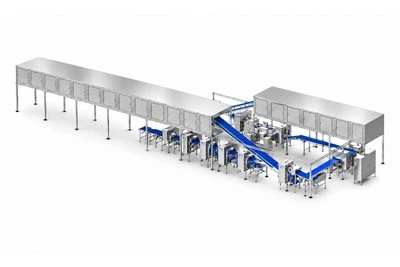
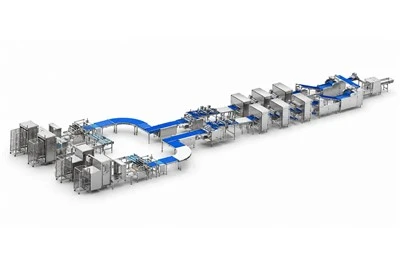
A modern Focaccia Production Line coordinates several processing stages, including:
Each stage influences the condition of the dough entering the next stage.
For example, inconsistent dough thickness during sheeting may result in different expansion rates during baking. Likewise, variations in proofing conditions can produce different gas distributions between batches.
This is why manufacturers should evaluate the entire production process rather than treating excessive puffing as an isolated baking problem.
4. How Can Manufacturers Reduce Excessive Puffing?
The goal is not to remove all the air from focaccia dough. Its characteristic open crumb depends on fermentation gases. Instead, manufacturers need to prevent excessive localized expansion while preserving the intended texture.
Here are several practical considerations.
Maintain Consistent Dough Preparation
Control dough hydration, mixing conditions, and gluten development according to the product formulation. Consistency at this stage helps reduce variations in dough structure.
Monitor Fermentation Conditions
Proofing time and temperature should be appropriate for the dough formulation and production schedule. Operators should also pay attention to uneven expansion and unusually large gas pockets before baking.
Use Appropriate Surface Dimpling
Dimpling, commonly known as docking in this context, is an important part of traditional focaccia preparation.
The characteristic indentations help create the familiar surface appearance and can also influence how the dough expands during baking. Depending on the dough condition, appropriate dimpling can help reduce excessive localized inflation.
However, the depth, spacing, and pressure of the dimples need to suit the product. Applying too much pressure may damage the dough structure and produce a denser crumb.

Optimize Baking Conditions
Oven temperature, baking time, and heat distribution all affect how the dough expands and sets.
If the outer structure sets while a large internal gas pocket continues expanding, the finished product may develop a hollow center. Therefore, baking conditions should be validated using the actual dough formulation, product thickness, and tray arrangement.
5. What Should Manufacturers Consider When Choosing a Focaccia Production Line?
For commercial bakeries planning to increase output, controlling dough quality manually across every production batch becomes increasingly difficult.
An industrial Focaccia Production Line should be designed around the characteristics of the product, rather than simply focusing on maximum production speed.
When evaluating equipment, manufacturers should pay attention to several processing requirements.
Dough Thickness and Portion Consistency
The dividing and sheeting systems should provide consistent dough dimensions. Uneven thickness can contribute to differences in proofing and baking performance.
Dough Handling and Transfer
High-hydration focaccia dough can be sticky and delicate. The transfer system should minimize unnecessary stretching or deformation before proofing and baking.
Proofing Control
Consistent proofing conditions help maintain a more predictable dough structure. Production capacity and proofing time should also be coordinated with upstream and downstream equipment.
Dimpling and Surface Preparation
The surface preparation system should create uniform indentations without excessively compressing the dough. Oil application and other topping processes may also need to be integrated according to the product design.
Baking Performance
The oven should provide suitable heat distribution and allow operators to adjust baking parameters according to the dough formulation and finished product requirements.
When these systems work together, manufacturers have better control over product dimensions, surface appearance, and internal crumb structure.
6. Why Customized Focaccia Production Equipment May Be Necessary
Not every focaccia manufacturer produces the same type of product.
Some factories focus on traditional olive oil focaccia, while others manufacture rectangular sandwich bread, individually portioned focaccia, or products with different toppings and thicknesses.
These variations can require different processing arrangements.
A Customized Focaccia Production Line may be considered when a manufacturer needs to accommodate:
- ✓ Different dough weights and product dimensions.
- ✓ Various dough thicknesses and shapes.
- ✓ Different production capacities.
- ✓ Automatic dimpling and oil application.
- ✓ Specific proofing and baking requirements.
- ✓ Integration with existing bakery equipment.
Before selecting a production configuration, it is helpful to define the target product, dough formulation, expected hourly output, and required level of automation.
This information allows the machinery manufacturer to evaluate the processing requirements and recommend a suitable production arrangement.

Conclusion
Focaccia that puffs up like pita bread during baking is generally associated with uneven gas distribution and excessive localized expansion. Dough hydration, gluten development, fermentation, handling, surface dimpling, and baking conditions can all influence the final result.
For commercial manufacturers, achieving consistent focaccia requires more than controlling the oven. The entire production process, from dough preparation to baking, needs to work together.
A properly configured Focaccia Production Line can help manufacturers improve process consistency, manage dough handling, and maintain the intended product shape and crumb structure.
If you are planning a new focaccia production facility or upgrading an existing bakery, choosing equipment according to your dough characteristics, product dimensions, and production targets is an important first step.
As a food processing machinery manufacturer, we provide production equipment solutions for different bakery requirements. Whether you need a standard production setup or a Customized Focaccia Production Line, our team can help evaluate your project and recommend suitable equipment.
Contact us to discuss your focaccia production requirements and explore the right production solution for your factory.
Request Equipment Consultation →