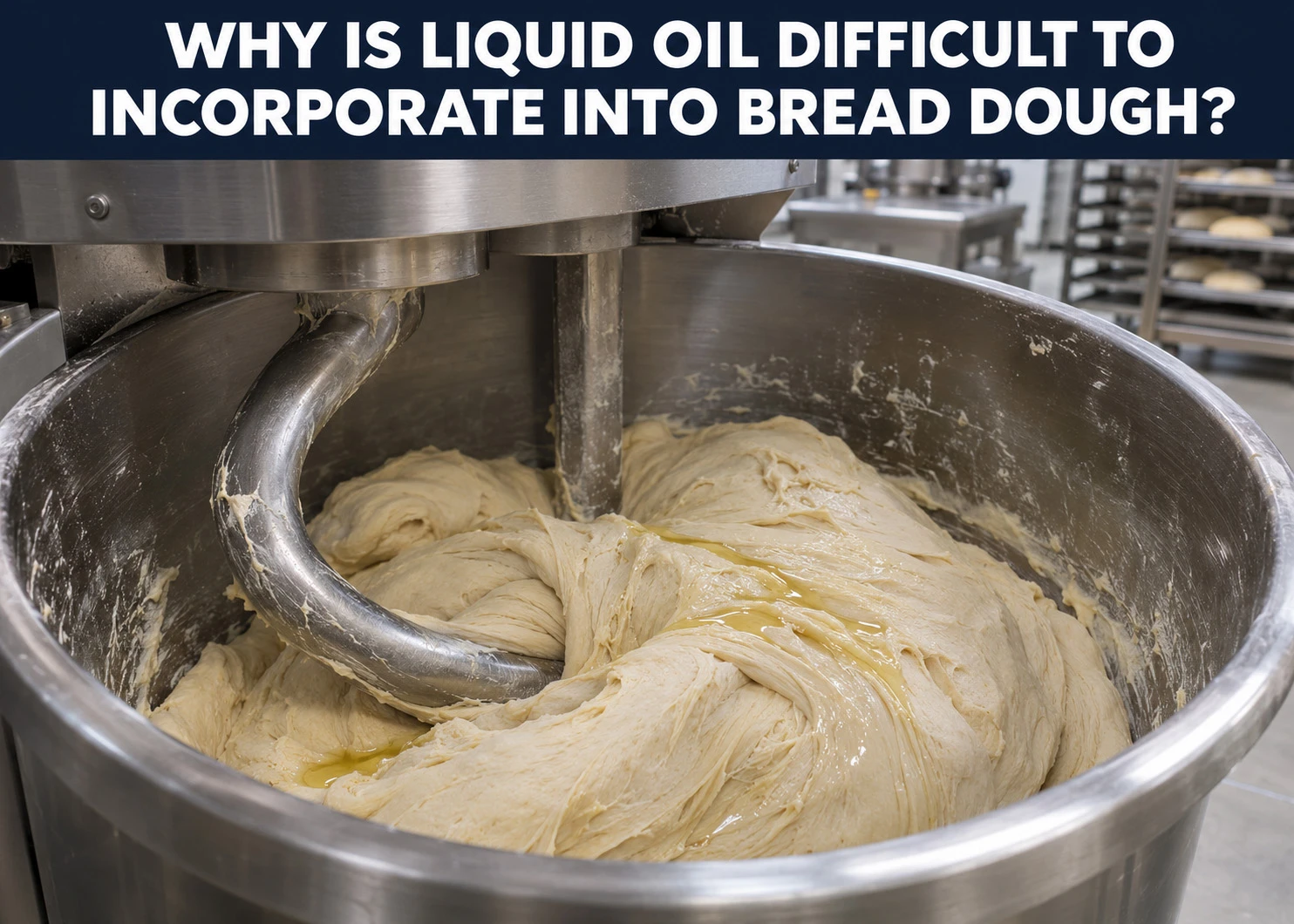

Liquid oils such as corn oil are commonly used in bread formulations to achieve a mild flavor and a soft crumb. However, when oil is added using the delayed-fat method, it can pool at the bottom of the mixing bowl, coat the dough surface, and make the dough slippery.
Compared with softened solid fats, liquid oil can take longer to distribute evenly through the dough under certain mixing conditions. Extending the mixing time may increase dough temperature and place additional stress on its developing gluten structure.
The key is not simply to mix longer, but to help the oil distribute more efficiently while protecting dough development.
1. Why Is Liquid Oil Difficult to Incorporate?
Liquid oil and solid fats behave differently during mixing. Solid fats such as butter have a degree of plasticity when properly softened, allowing them to deform and distribute as the dough is mixed.
Liquid oil has no comparable solid structure. When a large amount is added at once, it can spread across the dough surface and mixing bowl, reducing effective contact between the dough and the mixing tool.
The dough may become slippery before the oil has been evenly distributed. As a result, the mixer may need additional time to incorporate the oil and restore a cohesive dough structure.
Longer mixing can increase frictional heating and affect dough strength, particularly when temperature control is inadequate.
For manufacturers, the objective is to achieve uniform fat distribution without unnecessarily extending mixing time or compromising the dough's handling properties.
2. Method One: Chill the Oil to a More Viscous State
One approach is to cool the liquid oil before adding it to the dough.
Under suitable conditions, cooling can increase an oil's viscosity or cause partial crystallization, depending on its composition. This may make the oil less mobile during mixing and easier to distribute.
The original technique suggests chilling corn oil until it becomes partially solid or paste-like before incorporation. However, this result is not guaranteed for every oil. Different oils have different melting and crystallization characteristics, and some may remain liquid even at low temperatures.
Before applying this method, manufacturers should verify the oil's behavior at the intended temperature and confirm that cooling does not introduce unwanted variation into the formulation.
The oil should also be incorporated at a temperature that remains compatible with the dough's mixing requirements.
3. Method Two: Combine the Oil with Reserved Flour
Another approach is to use a portion of the formulation's flour to help distribute the liquid oil.
In the original technique, approximately 10% of the total flour is reserved during the initial mixing stage. Once the dough reaches an early stage of development, the reserved flour is combined with the oil to create a crumb-like mixture before being added back to the main dough.
The flour helps distribute the oil across a larger number of small particles rather than allowing the entire quantity to spread directly over the dough surface.
This can change how the oil contacts the dough during mixing and may help improve distribution under suitable formulation and equipment conditions.
However, the reserved flour still belongs to the original recipe. Manufacturers should account for it in the mixing sequence and verify that the revised process does not compromise dough hydration, gluten development, or finished bread quality.
The proposed 10% flour allocation is a starting point from the original technique, not a universal industrial specification.
4. Method Three: Try a Controlled Oil-and-Liquid Premix
A third option is to combine the oil with a portion of the recipe's liquid before adding it to the dough.
The original method suggests reserving approximately 10% of the water or milk and mixing it with the oil until the mixture appears slightly cloudy and more uniform.
Milk contains components that can contribute to emulsification, but a simple mixture of oil and water or milk is not necessarily a stable emulsion. Without a suitable emulsifier and mixing conditions, the phases may separate again.
For this reason, the premix should be evaluated according to the formulation rather than assumed to remain stable.
Avoid excessive aeration during preparation. Introducing unnecessary air can make the mixing process less consistent and may complicate evaluation of the dough's actual structure.
The goal is to improve oil distribution before incorporation, not to whip the mixture or create a foam.
5. Which Method Is Best for Bread Production?
The most suitable method depends on the oil, flour, recipe, mixer design, batch size, and required dough properties.
|
Method |
Main principle |
Important consideration |
|
Chilled oil |
Reduce oil mobility where the oil's properties allow |
Verify the oil's behavior at the target temperature |
|
Oil and reserved flour |
Distribute oil across flour particles before incorporation |
Maintain the original formulation and dough hydration |
|
Oil-and-liquid premix |
Prepare a more uniform feed mixture before mixing |
Check phase separation and formulation compatibility |
These methods should not be treated as interchangeable recipes for every bread formulation. A method that works with one oil or mixer may not produce the same result with another.
Manufacturers can compare the methods through controlled trials, keeping the formulation and batch conditions consistent while measuring mixing time, dough temperature, dough handling properties, and finished bread quality.
6. Why Does Oil Incorporation Matter in Industrial Dough Mixing?
In industrial bread production, mixing must deliver repeatable dough properties from batch to batch. Poor oil distribution can create inconsistencies in dough handling and make it more difficult to maintain stable downstream processing.
A well-controlled process coordinates:
Ingredient Preparation → Initial Mixing → Fat Incorporation → Final Dough Development → Dividing and Forming
The timing of oil addition, ingredient temperature, mixing speed, and total mixing time all influence the final dough condition.
For manufacturers using automated dough processing equipment, the aim is to establish a repeatable mixing procedure that distributes the oil effectively while maintaining the required dough temperature and structure.
Rather than relying on additional mixing time alone, manufacturers should identify the cause of poor incorporation and adjust the process accordingly.
Conclusion
Liquid oil can be difficult to incorporate using the delayed-fat method because it behaves differently from plastic solid fats during mixing.
Cooling the oil, combining it with reserved flour, or preparing an oil-and-liquid premix may help under suitable conditions. Each approach requires validation against the actual formulation and mixing equipment.
Better oil incorporation starts with understanding ingredient behavior, not simply extending mixing time.