
Muffins with tall, rounded tops are often associated with the right recipe and enough baking powder. Yet, even with the same formula, some muffins develop a high dome while others remain relatively flat.
The difference is not always the amount of leavening agent. Baking temperature, particularly during the initial stage, plays an important role in batter expansion and final product structure.
For manufacturers operating an automatic muffin production line, understanding this relationship helps establish more consistent baking conditions and product specifications.
1. Baking Powder Produces Gas, but It Does Not Guarantee a High Dome
Baking powder is a chemical leavening agent that releases carbon dioxide when activated by moisture and heat. As the batter heats up, gas expands and contributes to the rising process.
However, gas production is only one part of muffin expansion. The batter must also retain the gas long enough to expand before its structure sets.
If the batter sets before sufficient expansion occurs, the muffin may develop a lower top. Conversely, if the structure cannot retain gas effectively, the product may rise unevenly or lose volume.
This is why adding more baking powder is not always the answer. The objective is to coordinate gas production, batter expansion, and structural setting throughout baking.
2. How Does a High Initial Temperature Help Muffins Rise?
A commonly used technique is to begin baking at a relatively high temperature and then reduce the temperature for the remaining baking time.
For example, some recipes begin at approximately 218°C (425°F) for five minutes before reducing the temperature to around 177°C (350°F). These are reference settings rather than universal industrial parameters.
The initial heat encourages rapid expansion while the batter is still capable of rising. As the muffin develops its rounded top, the lower finishing temperature helps the center bake through without excessive browning.
The underlying principle is not simply to make the oven as hot as possible. It is to establish a suitable temperature profile that supports expansion early in the process and complete baking afterward.
Actual settings depend on batter composition, portion weight, mold dimensions, oven design, and the required product characteristics.
3. Why Is the Baking Profile Important in Industrial Production?
In small-batch baking, an operator can adjust a recipe or baking cycle from one batch to the next. Industrial production is different: the same product specifications must be maintained across many portions and repeated production runs.
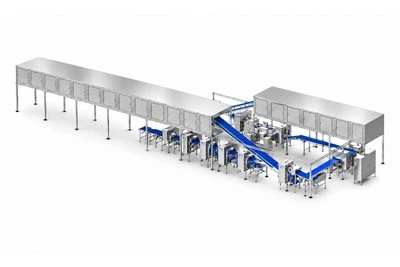
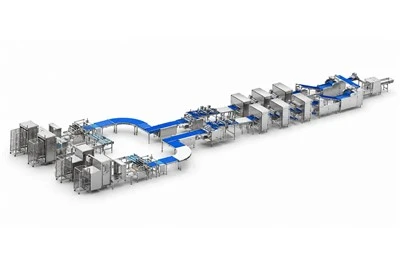
An automatic muffin production line needs a baking profile that works with continuous depositing, conveyor movement, and the available oven zones.
Three factors are particularly important:
Initial heat input: The batter needs suitable conditions to expand and develop the desired top.
Baking duration: The product must receive enough heat to develop its internal structure and finish baking.
Temperature consistency: Differences between oven zones or production runs can create variations in height, color, and texture.
A temperature profile that works well for one muffin size may not perform equally well for a larger portion or a different formulation. Baking conditions should therefore be validated against the actual product.
4. How Can Manufacturers Establish a Suitable Baking Profile?
Rather than relying on a single temperature setting, manufacturers can evaluate the baking process systematically.
First, confirm the actual oven temperature instead of relying only on the controller's displayed setpoint. Differences between the set temperature and the measured temperature can affect product expansion.
Next, evaluate the initial baking stage and the finishing stage separately. Observe muffin height, surface color, internal texture, and whether the center is fully baked.
Finally, repeat the test under consistent conditions. Batter formulation, deposited weight, mold configuration, and conveyor speed should remain controlled while the baking profile is evaluated.
For an automatic muffin production line, this process helps identify a repeatable operating window rather than a setting that works only under one particular set of conditions.
Conclusion
A high muffin dome is not determined by baking powder alone. It depends on how gas production, batter expansion, and structural setting work together.
For manufacturers using an automatic muffin production line, a suitable initial temperature followed by controlled finishing conditions can help improve product consistency and achieve the required shape and texture.
The goal is not simply higher heat, but a baking profile designed for the product.