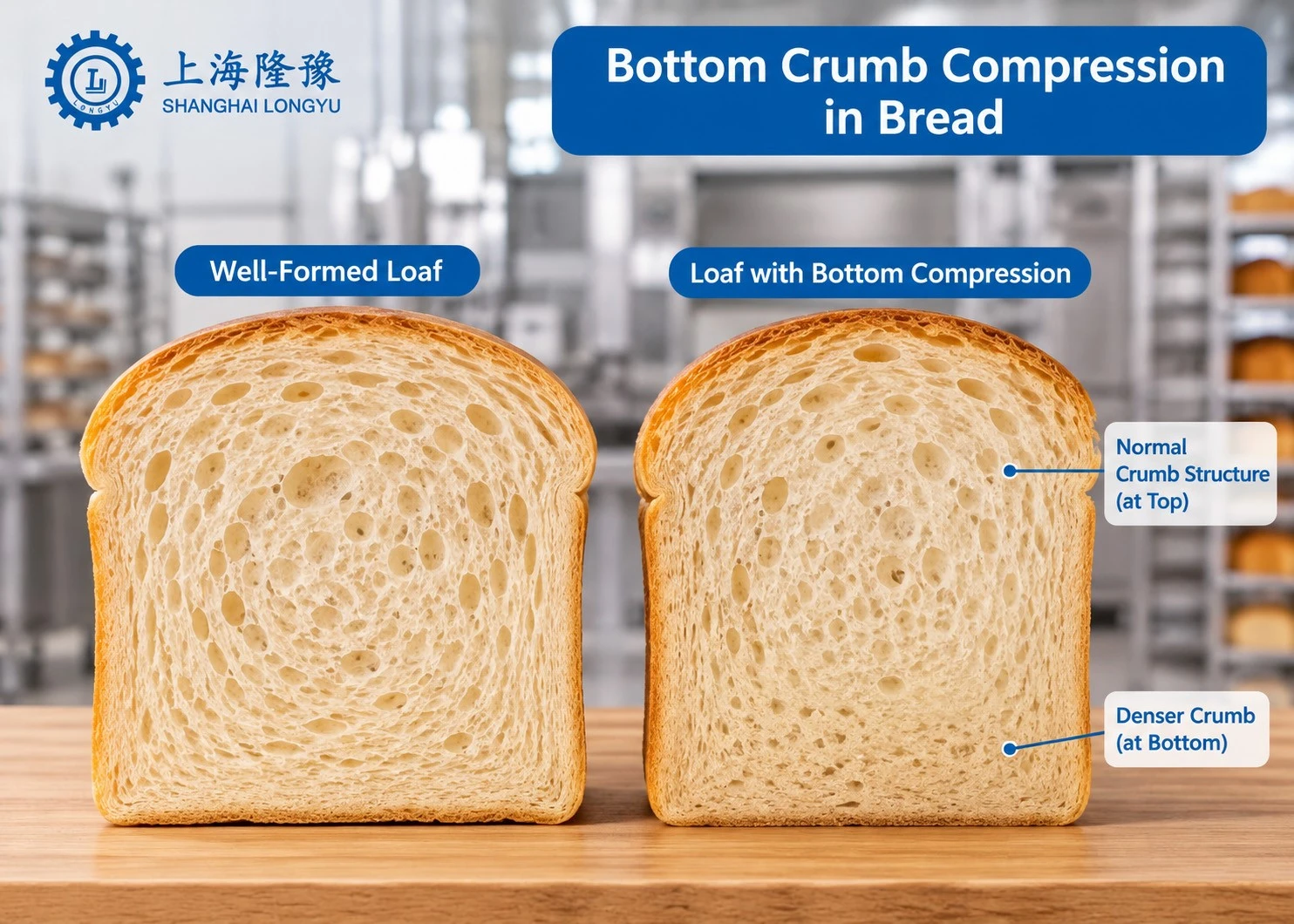

Have you ever sliced a loaf of sandwich bread and found a compact, firm layer along the bottom? The upper crumb may look soft and airy, while the bottom contains smaller holes and a noticeably tighter texture.
This defect is often described as a dense bottom layer in sandwich bread. It can result from several factors, including dough strength, shaping technique, proofing conditions, and the balance between oven heat and structural setting.
The key is to understand whether the dough lacks sufficient support or the bottom sets at the wrong stage of baking.
1. How Does Dough Strength Affect the Bottom Crumb?
Dough needs sufficient strength to retain fermentation gases and support expansion during baking. If gluten development is insufficient, the dough may struggle to maintain its structure as it expands.
However, excessive mixing can also damage dough structure under certain conditions. The ideal mixing endpoint depends on the flour, formulation, and production process.
When the dough cannot retain its structure effectively, the lower portion may become compressed, contributing to a dense bottom layer in sandwich bread.
What to check:
Dough development and elasticity after mixing
Consistency between batches
Dough handling properties during dividing and shaping
Whether the finished loaf shows other signs of weak structure
The objective is not necessarily to mix until the dough reaches the thinnest possible windowpane. It is to develop the strength required for the intended bread and subsequent processing stages.
2. Can Shaping and Sealing Cause a Dense Bottom?
Shaping influences how the dough is distributed inside the pan and how its structure behaves during proofing and baking.
If the dough is rolled too aggressively or the seam is compressed excessively, the lower portion may become locally dense. Overly tight shaping can also create uneven internal tension, affecting how the dough expands.
When the loaf is placed in the pan, the seam is generally positioned downward. However, the seam should be sealed sufficiently to hold its shape without unnecessarily compressing the surrounding dough.
For a more consistent crumb, manufacturers should aim for controlled rolling, even dough thickness, and repeatable seam formation.
3. How Does Final Proofing Affect the Bottom Layer?
Final proofing prepares the dough for baking by allowing it to expand and develop its internal gas structure.
If proofing is insufficient, the dough may enter the oven while still relatively tight. Its expansion may be limited or uneven, producing a compact crumb in some areas.
Excessive proofing can also weaken the dough's ability to retain its structure, potentially leading to collapse or uneven crumb development.
Rather than relying on proofing time alone, manufacturers should evaluate dough volume, surface condition, elasticity, and the response of the dough to handling.
For pan bread, the appropriate proofing endpoint depends on the recipe, pan dimensions, dough weight, and whether the loaf is baked with a lid.
4. Why Does Bottom Heat Matter?
The bottom of a loaf must receive sufficient heat to bake the dough and establish a stable structure. However, the timing of heat transfer matters as much as the nominal temperature.
If the bottom receives excessive heat early, its structure may set before the surrounding dough has completed expansion. This can produce a firm, darkened lower crust and may contribute to a compact bottom region.
Conversely, insufficient bottom heat may delay setting. The lower dough can remain weak while the upper portion continues expanding, potentially contributing to compression and an underbaked or dense texture.
These outcomes are not identical, so manufacturers should distinguish between a thin, hard, dark bottom layer and a pale, soft, compact region.
Practical checks include:
Measuring actual oven temperatures rather than relying only on controller settings
Checking the balance between upper and lower heat
Reviewing pan position and oven loading
Comparing the bottom crust and internal crumb after baking
Baking conditions should be adjusted according to the oven design, pan material, loaf weight, and formulation.
5. How Can Industrial Production Improve Bottom Crumb Consistency?
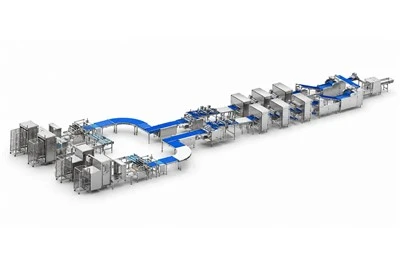
In an automatic bread production line, the final crumb depends on coordinated dough preparation, dividing, rounding, molding, proofing, and baking.
Variations introduced during mixing or shaping may become more visible after baking. Likewise, inconsistent proofing or uneven heat transfer can produce differences between loaves from the same batch.
A systematic approach is therefore more effective than changing several parameters simultaneously.
First, check whether the defect appears consistently across all loaves or only in specific pans or oven positions. Next, review dough development, shaping, and proofing conditions. Finally, evaluate the baking profile and compare the resulting crumb structure.
This approach helps manufacturers identify the process stage most likely responsible for a dense bottom layer in sandwich bread.
Conclusion
A dense bottom layer is not necessarily caused by a single mixing or baking mistake. Dough strength, shaping pressure, proofing conditions, and bottom heat can all influence the final crumb.
For industrial bread manufacturers, consistent results come from coordinating these processes and evaluating the finished loaf rather than adjusting one parameter in isolation.
The goal is a loaf that expands evenly and develops a uniform crumb from top to bottom.